Landing a job in sound design really comes down to two things: your technical chops and your creative instincts. It's one thing to know the software, but it's another thing entirely to use it to bring a story or experience to life. Hiring managers are looking for that perfect blend of both.
If you want to get hired, you need more than just a good ear. You need a specific, well-rounded skill set that proves you can handle the job from day one.
At the very top of that list is fluency in a Digital Audio Workstation (DAW). You absolutely have to know your way around at least one. While Pro Tools has long been the king in film post-production, being comfortable with alternatives like Reaper or Nuendo can make you a much more appealing candidate, especially for game audio gigs.
But it’s not just about knowing where the buttons are. You need a solid grasp of fundamental audio principles. This means everything from proper gain staging and microphone placement to the nuances of signal processing with EQs, compressors, and reverbs. You have to show that you understand why you're using a specific tool to solve a problem, not just that you know how to open a plugin.
Your technical abilities are the foundation, but your creative application is what makes you stand out. A hiring manager isn't just looking for a technician; they're looking for an artist.
Can you synthesize a creature's roar from scratch? Can you perform and record foley that feels so real it pulls the viewer deeper into the scene? These are the skills that show you can build a unique sonic world, not just pull sounds from a library.
This map breaks down how those core skills are put to use across different industries.
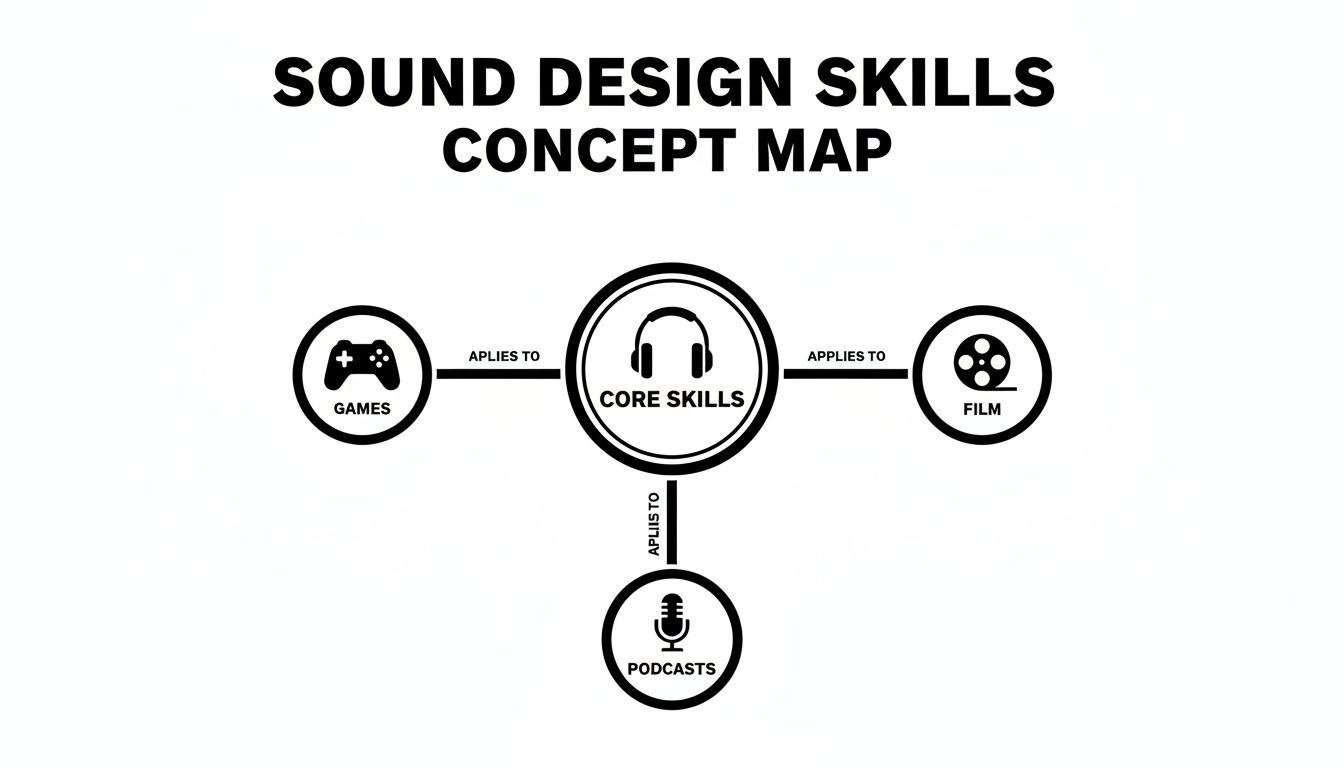
As you can see, the fundamentals are the same everywhere, but how you apply them changes drastically depending on whether you're working on something interactive like a game or something linear like a film.
While a good sound designer can often move between industries, each sector has its own unique demands and prioritizes certain skills over others. Understanding these differences is key to tailoring your portfolio and resume to the specific jobs you're applying for.
| Skill Category | Video Games | Film & Television | Podcasting & Audiobooks |
|---|---|---|---|
| Primary Software | DAWs (Reaper, Nuendo), Game Engines (Unreal Engine, Unity), Audio Middleware (Wwise, FMOD) | DAWs (Pro Tools is the standard), specialized plugins for mixing and restoration. | DAWs (Audition, Reaper), Noise Reduction plugins (iZotope RX), efficient editing tools. |
| Core Technical Tasks | Asset creation, implementation, scripting interactive audio events, optimization for game performance. | Dialogue editing, foley, ADR, SFX editing, surround sound mixing (Dolby Atmos), conforming to picture. | Dialogue cleanup, noise removal, mixing for clarity and intelligibility, mastering for loudness standards. |
| Creative Focus | Building adaptive, non-linear soundscapes that react to player actions. Creating memorable, iconic sounds. | Enhancing the narrative, building emotional impact, creating a believable world through layered audio. | Ensuring a clean, professional, and listenable experience. Using music and SFX to support storytelling. |
| Most Valued Skill | Implementation. Being able to get your sounds working perfectly inside the game engine is non-negotiable. | Mixing. The ability to balance dialogue, music, and effects into a seamless final product is paramount. | Efficiency. The turnaround is often fast, so clean, high-quality editing done quickly is highly valued. |
This table gives you a practical look at what hiring managers are searching for in each field. A game studio will want to see your Wwise project, while a post-production house will focus on your Pro Tools session organization and mixing skills.
The single most valuable skill a sound designer can have is adaptability. Tools, techniques, and entire workflows are always changing. Your willingness to learn and evolve is what will keep you employed for the long haul.
Staying on top of new developments is part of the job. It's a good idea to keep an eye on resources covering the latest advancements in audio AI to see where the industry is heading. And if you need to brush up on the basics, our in-depth guide to sound design is a great place to start.
Let’s be honest: your portfolio is everything. It’s the single most powerful tool you have to land a job in sound design. It's more than a collection of projects; it’s your professional story, your creative fingerprint, and the undeniable proof that you can deliver the goods. A killer portfolio shows a hiring manager not just what you can do, but how you think.
Forget the "kitchen sink" approach of dumping every audio file you've ever made onto a webpage. A portfolio that gets you hired is curated, focused, and laser-targeted to the gigs you're chasing. If you want to work in game audio, it better scream interactivity. If you’re aiming for film, it needs to bleed storytelling and emotional weight.
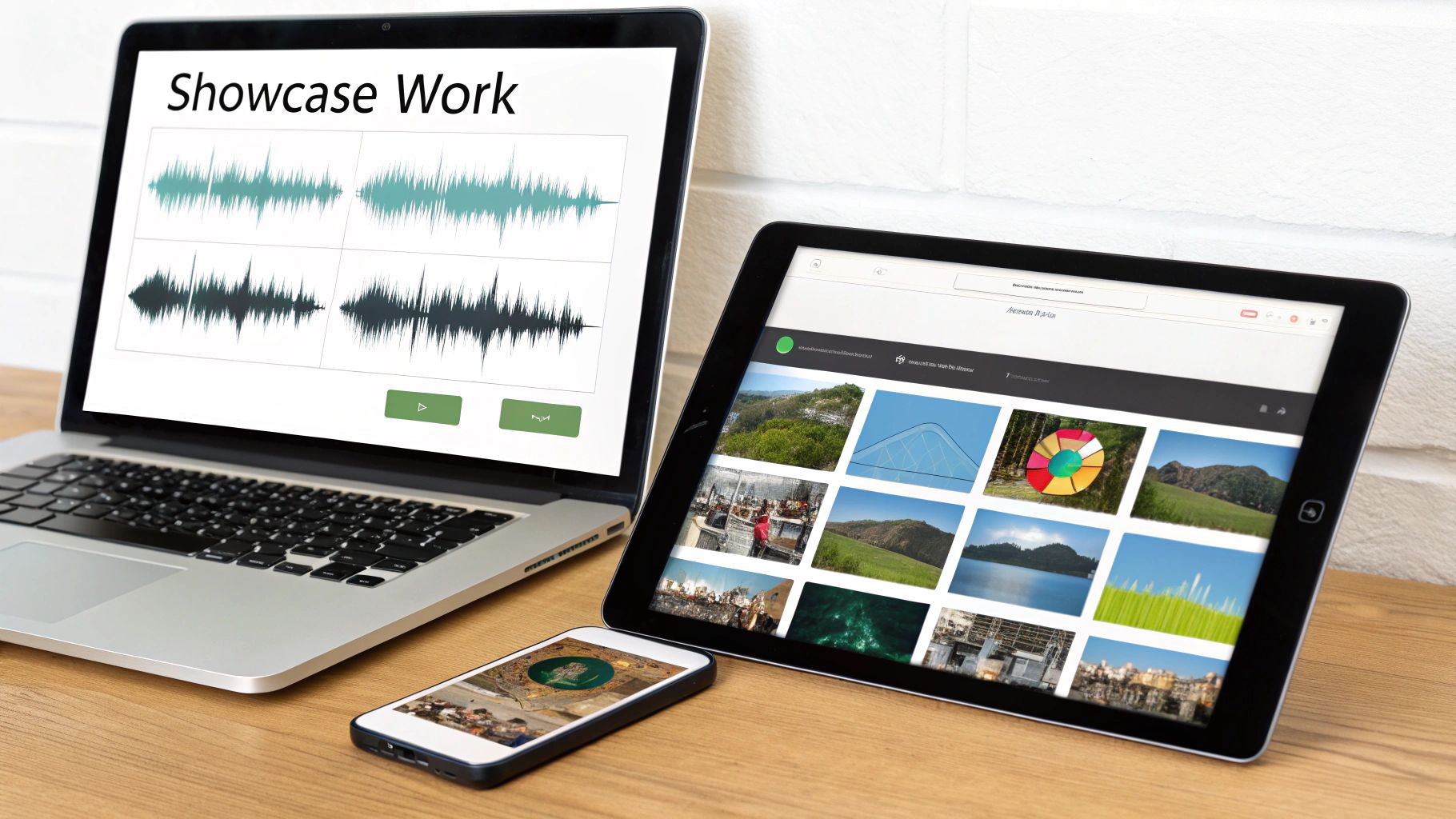
The most common portfolio piece is the trailer redesign. It’s a rite of passage, but the bar is set high. Just slapping new sounds over a cool video clip won't cut it anymore—everyone does that. To really stand out, you have to show your work.
Don’t just present the final product. Create a breakdown video that shows the "before" and "after," and then walk us through your process. Explain why you chose that metallic screech for the robot's joints or how you layered three different animal recordings to create a creature's roar. This is your chance to peel back the curtain.
Key Takeaway: A portfolio that explains the "why" behind your creative choices is infinitely more powerful than one that just presents the final result. It shows recruiters you’re a thoughtful designer, not just a technician.
To build a portfolio that truly turns heads, you need projects that prove you can think like a pro and handle a variety of challenges.
The Advanced Game Trailer Redesign: Take the standard redesign and kick it up a notch. After creating your sounds, implement them in Wwise or FMOD. Capture a video of your session, showing how your audio dynamically responds to in-game events. This is gold—it proves you understand the entire game audio pipeline, not just asset creation.
The Short Film Soundscape: Find a short, dialogue-free animated film online and build its entire sonic world from the ground up. This is a massive opportunity to showcase your range. You'll tackle foley for tiny character movements, design rich, evolving ambiences, and craft key sound effects that drive the narrative. It shows you can create a cohesive, immersive world.
The Cinematic "One-Shot": Pick a single, complex scene from a movie—something around 1-2 minutes long—and completely rebuild its sound. This is where you obsess over the details: the subtle rustle of clothing, the layered city backgrounds, the dynamic shifts in the mix that ramp up the tension. It’s a masterclass in detail and polish.
To bring these projects to life, you’ll need a solid library of sounds. While recording your own is a crucial skill, supplementing with high-quality assets is standard practice. For those just starting out, exploring some of the best free sound effects can give you the raw materials you need without breaking the bank.
The way you present your work is just as important as the work itself. Recruiters are busy and spend mere minutes on each application, so your site needs to be clean, professional, and dead simple to navigate.
Grab a simple website builder like Squarespace, Wix, or even a well-organized ArtStation profile. The first thing anyone should see is your demo reel—front and center. For each project, write a short, clear description of what you did and the skills you used. And for goodness' sake, make sure every video and audio clip loads quickly and plays perfectly on a phone. Your portfolio is your handshake, so make it a firm one.
Alright, you've built up a solid portfolio. Now it's time to create the two things that will actually get your foot in the door: a sharp resume and a killer demo reel. Think of these as your one-two punch for landing interviews. In the sound design world, hiring managers have very specific expectations for both.
Your resume isn't just a list of old jobs; it's a technical snapshot. Recruiters want to immediately see what tools you know. Create a dedicated "Skills" or "Proficiencies" section right near the top and list every relevant DAW, game engine, audio middleware, and plugin you're comfortable with.
Don't be vague. Instead of just "Pro Tools," specify your level, like "Pro Tools Certified User." This small detail instantly signals you have the technical chops they need.
Beyond just the audio-specifics, a well-organized professional document is crucial. It's worth learning the ins and outs of creating a powerful curriculum vitae to make sure your project experience and unique skills really shine.
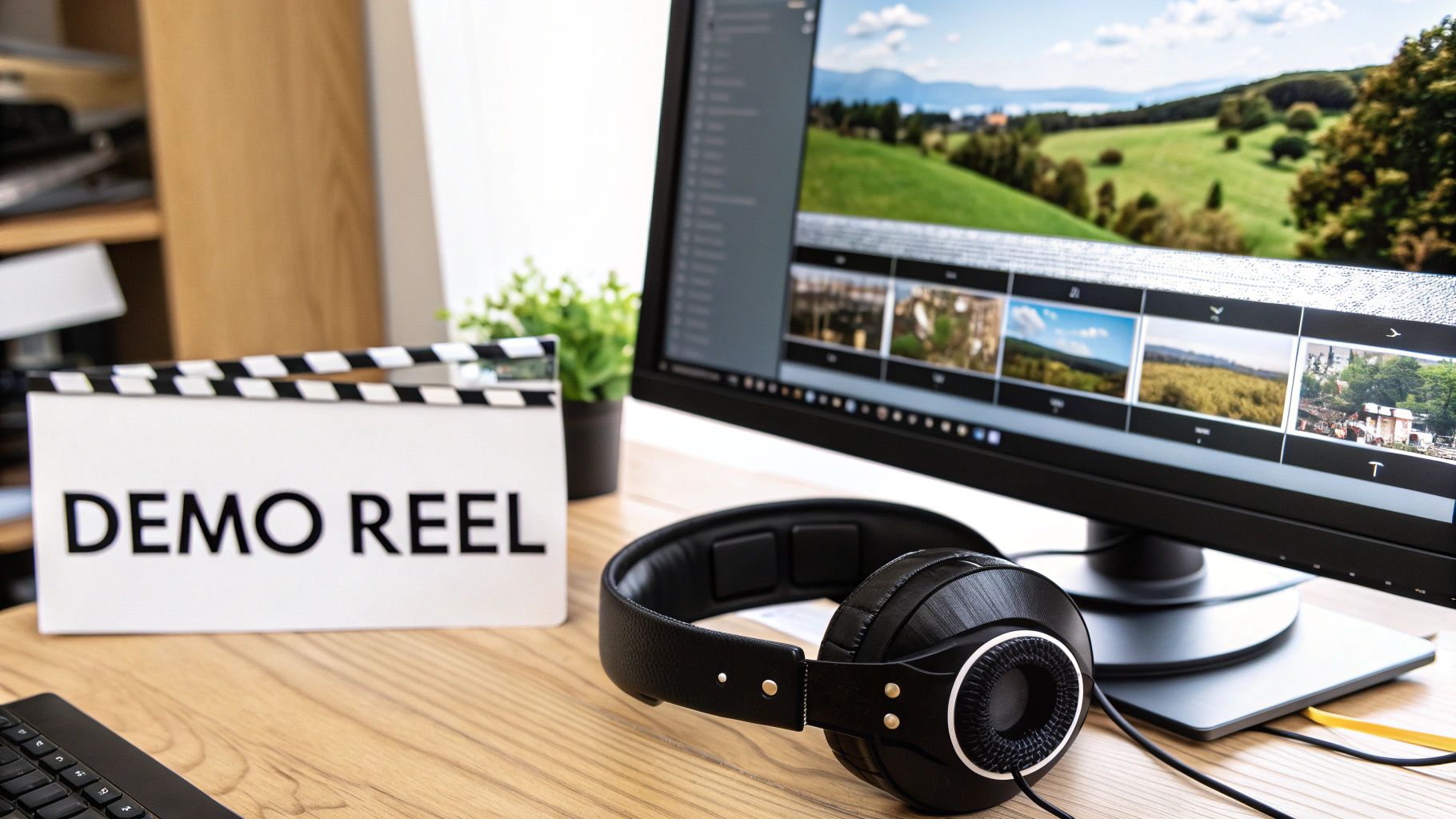
Let’s be clear: your demo reel is the single most important part of your application. It’s your audio handshake, and you’ve got maybe 15 seconds to make an impression before a busy recruiter moves on. Your opening has to be your absolute best, most jaw-dropping work.
Think of your reel's structure like a mini-story to keep them hooked.
A great reel demonstrates not only what you can create but also that you understand pacing and presentation. The flow of your reel is just as important as the sounds within it.
I’ve seen incredibly talented designers get passed over because of simple, avoidable mistakes. Your job is to make the recruiter's life as easy as possible.
Steer clear of these common pitfalls:
Your resume and reel need to work together to paint a complete picture of who you are as a designer. If you feel your toolkit could use an upgrade, check out our guide on the best audio editing software to ensure your work sounds as professional as possible. A polished presentation is what turns your skills into a career.
Alright, your demo reel is killer and your resume is sharp. Now comes the real challenge: landing a job. If you're just scrolling through the big, mainstream job boards, you're only seeing a fraction of what's out there. The best gigs are often hidden, and in a field this competitive, you need to know where to look.
Let's be real for a second. The market for audio pros is tight. The Bureau of Labor Statistics is only projecting a 1% growth for sound technicians between 2024 and 2034. That sounds a little grim, but it still means about 11,100 jobs open up each year as people retire or move on. You can dig into the full sound engineering career projections on BLS.gov yourself.
What this number really tells us is that you can't afford to just send out applications into the void. You need a better strategy.
Sure, check the huge job sites, but don't spend all your time there. The real magic happens in the niche corners of the internet where audio professionals actually hang out. These are the places hiring managers look first.
Here's the secret that experienced pros know: most of the best sound design jobs are never even advertised. They get filled through referrals and personal connections. This is the hidden job market, and it’s where your networking efforts pay off.
Networking isn't just about schmoozing or collecting LinkedIn contacts. It's about building real relationships. You want to be the first person someone thinks of when they hear about a new project, long before a job description is even written.
Start small. Connect with your peers, not just studio directors. Follow sound designers whose work you love on social media. Don't just be a silent follower—engage with their posts, ask smart questions, and join the conversation. If there are local game dev meetups or industry events nearby, go.
Your goal is to become a known quantity in the community. When a friend who works at a studio can vouch for your skills and your passion, your application goes straight to the top of the pile. This approach takes time and effort, but it’s how sustainable, long-term careers are built.
You’ve landed the interview. This is the final step, the moment where all your hard work building a portfolio and resume pays off. This is where you get to give your work a voice and show a potential employer not just what you can do, but how you think.
A sound design interview is its own unique beast. It’s a mix of talking about your experience, diving deep into technical specifics, and, very often, facing a creative challenge on the spot.
Don't be surprised if they give you a practical test. I've seen everything from a quick audio quiz to being handed a silent animation and asked, "How would you score this?" They're not just looking for a list of sound effects; they want to see your mind at work.
When you get a prompt like this, resist the urge to just list sounds. Instead, narrate your entire creative process. Talk them through how you'd establish the environment first, then move to the essential character foley, and finally layer in the big, narrative-driving moments. This approach shows you're a designer who thinks about the story, not just someone who pulls sounds from a library.
Beyond the creative side, they'll want to know you can slide right into their existing workflow without a hitch. This means getting into the nitty-gritty of how you work.
Get ready for questions like:
These questions are designed to separate the hobbyists from the pros. Have specific examples from your portfolio ready to go. Being able to clearly and concisely reference your own projects shows you're a professional who can hit the ground running.
My Two Cents: Your ability to explain why you made a creative choice is just as critical as the choice itself. Before any interview, practice talking through your favorite portfolio pieces out loud. It makes a world of difference.
After you've wowed them with your portfolio and process, the conversation will eventually turn to money. This part can feel awkward, but walking in armed with data is the best way to feel confident. The simple truth is that skilled audio professionals are more in demand than ever.
In fact, the audio engineering field has seen a solid bump in pay, with average salaries climbing from around $65,000 in 2019 to an estimated $79,280 by 2025. That's a 22% jump in just six years, which tells you everything you need to know about the growing demand for our skills. For a closer look, you can dig into the 2025 audio industry salary insights on SonicScoop.com.
Having those industry averages in your back pocket is a game-changer. When an offer comes in, remember that you don't have to say "yes" on the spot. It's completely normal and expected to thank them and ask for a day to look everything over.
If their first number feels low compared to your research and experience level, it's time to prepare a counteroffer. This isn't about being confrontational; it's about being professional. Frame your counter by connecting it to the specific value you bring, the skills you have that they need, and the industry data you've gathered.
A calm, well-supported negotiation doesn't just get you a better salary—it shows them you're a serious professional who knows their value. It's the first step in building a great working relationship.
Breaking into the world of sound design means you're going to have questions. It's a unique industry with its own rules and expectations, so let's tackle some of the most common things aspiring audio pros wonder about.
Getting clear, straight answers helps you focus your energy where it actually counts. These are the practical realities of what it takes to build a career in this field.
Honestly, not always. While a degree in audio engineering or something similar can give you a great theoretical foundation and some solid connections, it’s not the hard-and-fast requirement you might think. This industry values what you can do above all else.
Your portfolio and demo reel are your real calling cards. A killer collection of work that proves you have both technical chops and raw creative talent will always speak louder to a hiring manager than a diploma. Plenty of top-tier sound designers are self-taught or have sharpened their skills through specialized certificate programs.
This is a big one, and it really comes down to a choice between stability and autonomy. Going in-house means you're a salaried employee at a single company—think a game studio or a post-production house.
That route usually comes with a steady paycheck, benefits, and the opportunity to become deeply involved in a company's specific projects. A freelancer, on the other hand, is running their own business. You'll be juggling multiple clients and projects simultaneously, which offers amazing flexibility and variety. The trade-off? You have to be good at marketing, invoicing, and managing client relationships.
This choice fundamentally shapes your day-to-day. One path gives you a built-in team and a consistent workflow; the other offers the freedom to build a diverse client list and be the master of your own schedule.
It’s everything. The sound design community is surprisingly small, and a huge number of jobs get filled through referrals long before a public job ad ever goes up. This is often called the "hidden job market," and it's very real.
Building genuine relationships is the key to a sustainable career. Start by showing up—attend industry events (virtual ones count!), get active in online audio forums, and connect with other sound pros on social media. Networking isn't just about scoring your next gig; it's about weaving yourself into the fabric of the industry and building a support system that will last for years.
Ready to create the custom sound effects that will make your portfolio unforgettable? With SFX Engine, you can generate unique, royalty-free audio from a simple text prompt. Stop searching for the perfect sound and start creating it. Try SFX Engine for free and bring your sonic ideas to life today.