
Ghostly sound effects are much more than just spooky noises. They’re carefully crafted audio illusions meant to tap into our primal fears, often blending high-frequency whispers with deep, gut-wrenching rumbles to create a sense of the supernatural. To do it right, you have to get inside the listener’s head and understand what truly makes a sound feel haunted.
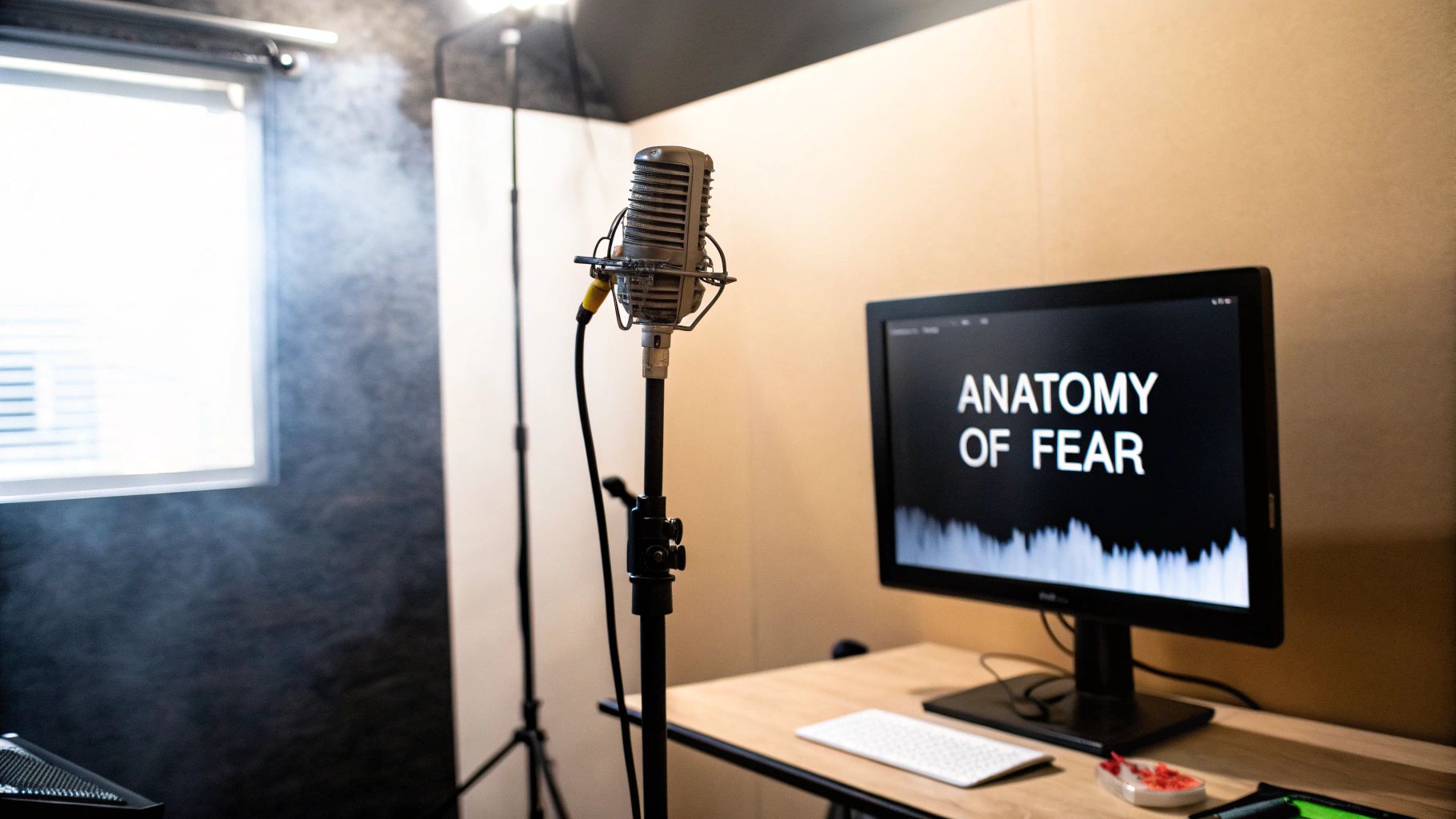
Before you even think about opening your DAW, let's talk about what makes a sound genuinely unsettling. Great horror sound design isn't about throwing random creaks and groans at the wall; it’s about psychologically manipulating the listener. Our brains are hardwired to react to certain sonic cues, and learning to pull those strings is the secret to creating ghostly sounds effects that linger.
Sound is a powerful storyteller. The best spectral audio implies a story about an unseen presence—its character, its size, even its intent—using nothing but frequency and vibration.
Take a high-pitched, breathy whisper. It instantly puts us on high alert, suggesting something is right there, invading our personal space. This is a direct attack on our instinctual defenses. On the other end of the spectrum, a deep, low-frequency rumble that you feel in your chest more than you actually hear suggests something enormous and powerful. This kind of infrasound can physically create anxiety and dread, even when it’s barely audible. It's the audio equivalent of a looming shadow you can't quite see.
Building a believable ghost requires thinking in layers. Each component you add should have a specific job in the overall sonic picture. Here are the fundamental building blocks we'll be working with:
Don't forget the most powerful tool you have: silence. The absence of sound is a master of suspense. A well-timed moment of quiet forces the listener to lean in, making the eventual return of your ghostly sounds effects so much more shocking. Sometimes, a sudden silence is far more terrifying than the loudest scream.
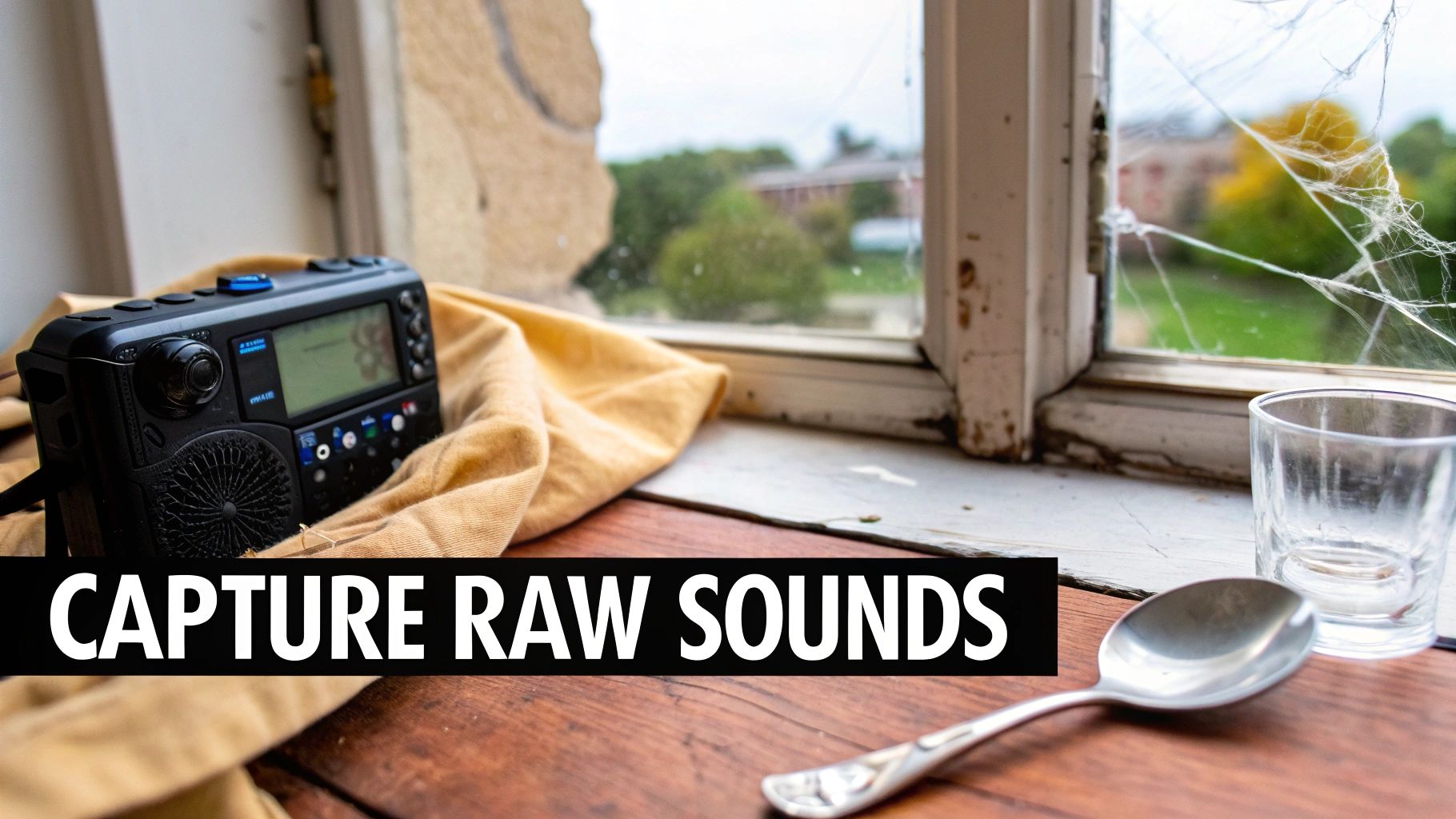
The most convincing ghostly sounds effects almost never come straight out of a pre-made library. They're born from unique, organic recordings you make yourself. Forget the idea that you need a pristine, acoustically treated studio. Your best spectral source material is probably hiding in plain sight, waiting for you to capture it with a simple microphone and a bit of imagination.
The real goal here is to hunt for raw character. We're not trying to record clean, perfect sounds. Instead, we're looking for textures loaded with imperfections—the very things we can later stretch, mangle, and process into something truly paranormal. Your house, your garage, and even your own voice are goldmines for this kind of material.
The trick to building a powerful source library is learning to hear the hidden sonic potential in everyday objects. Start thinking in terms of textures, friction, and resonance. For example, scraping a cello bow across the edge of a metal cymbal creates a piercing, sustained shriek that, when slowed down, morphs into a soul-crushing moan. Pressing dry ice against a metal baking sheet makes it scream and sizzle in a way that's impossible to fake with a synthesizer.
Here are a few places to start your sonic treasure hunt:
This whole process is really an art form in itself. If you want to go deeper into the craft of recording everyday objects to build a soundscape, you can learn more about what Foley sound is and how the pros use it in film and games.
To get your creative gears turning, here's a breakdown of how you can transform simple items into something much more sinister.
This table is a starting point. The real magic happens when you start experimenting with your own objects and recording techniques.
| Source Material | Recording Technique | Potential Ghostly Sound Effect |
|---|---|---|
| Old rocking chair | Record very close to the creaking joints as you slowly rock back and forth. | A rhythmic, sorrowful groaning or a sudden, sharp wood-stress sound for a jump scare. |
| Your own breathing | Exhale slowly through a cardboard tube or into a large glass jar. | A disembodied, hollow breath that feels like it's right behind the listener. |
| Metal Slinky | Hold one end and let the rest hang, then tap or scrape it with a fork. | Ethereal, resonant chimes and scrapes that can be reversed for an unnatural feel. |
| Popping bubble wrap | Record the pops in a highly reverberant space, like a tiled bathroom or stairwell. | Sharp, unsettling transient sounds that can be layered to create a sense of crackling energy. |
| Dragging furniture | Slowly drag a heavy wooden chair or table across a rough floor. | A deep, guttural groan of a large entity or a tense, scraping buildup. |
The key is to listen for the unexpected. What happens when you pitch that chair drag down two octaves? Or drench the bubble wrap pops in a massive reverb? Every recording is a new opportunity.
When you hit record, think like a performer, not a documentarian. Don't just capture a single, static sound. Instead, perform it. Give it variation in intensity, speed, and emotion. If you're scraping a piece of metal, try a few long, slow drags, then follow up with short, frantic scratches.
Remember, you're not recording a finished sound—you're capturing raw building blocks. A ten-second recording of a groaning door hinge can become a two-minute ambient texture or a half-second jump scare. Always record more than you think you need.
This variety is what will make or break your final design. The more nuance you capture at the source, the more life and believability your ghostly effects will have. Don't be afraid to experiment and even make a few mistakes. Sometimes the most unexpected noises produce the most terrifying results. You're building a personal library of unique textures that no one else has.
A single sound on its own rarely sounds genuinely paranormal. The ghost effects that truly get under your skin are almost always a composite, built from several carefully chosen audio sources. Think of it less like recording and more like sonic sculpting—you’re taking different textures and fusing them into something that couldn't exist in the real world.
The trick is to give each layer a specific job. One sound might provide the core emotional character, another adds a gritty texture, and a third gives it a sense of weight and presence in the space. By blending these elements, you’re not just making a spooky noise; you're crafting an immersive spectral experience.
Let's break down how this works with a hands-on example. Our goal is a spectral moan—something that feels both organic and deeply unnatural. To get there, we’ll combine three completely different elements.
Instead of just recording a person moaning, we'll build our ghost's voice from scratch. Each piece we add will serve a unique purpose in the final design.
When you mix these three sources, they stop being individual sounds. The listener doesn't hear a whisper, a cymbal, and a bass tone. They hear one complete, terrifying spectral moan.
The magic here is that the final sound becomes far more than the sum of its parts. Each element loses its individual identity to create a new, unified sonic illusion that feels impossibly real.
Recorded sounds are fantastic for dynamic, character-filled moments, but sometimes you just need a persistent, underlying dread. That’s where synthesis comes in. A simple synth patch can generate an unnerving drone that sits beneath your main effects, and you don’t need a fancy synthesizer to do it.
Often, a simple sine wave is all it takes. By using a very slow LFO (Low-Frequency Oscillator) to slightly modulate the pitch, you create a subtle, wavering tone that never quite settles. That instability is what makes it so effective. Our ears are wired to notice change, and this slow, almost imperceptible pitch drift creates a feeling that something is fundamentally "wrong" with the environment.
This synthetic drone acts as atmospheric glue. Mix it in quietly under your layered whispers and textures. It fills out the frequency spectrum and establishes a baseline of tension, making sure the listener never feels completely safe, even when the main ghostly sounds have faded out.
Once you have your raw sounds layered up, the real magic begins. This is where we take those organic, even recognizable, recordings and twist them into something genuinely terrifying. The goal isn't just to slap on some effects; it's about meticulously reshaping every sonic detail until the sound feels truly supernatural and unsettling.
Your processing chain is like a custom toolkit you build for each sound. Each plugin plays a specific part in carving, coloring, and contorting the audio, so think of it less like a rigid formula and more like an artist’s palette.
This workflow is all about taking simple ingredients and combining them into a complex raw material for your processing chain to chew on.
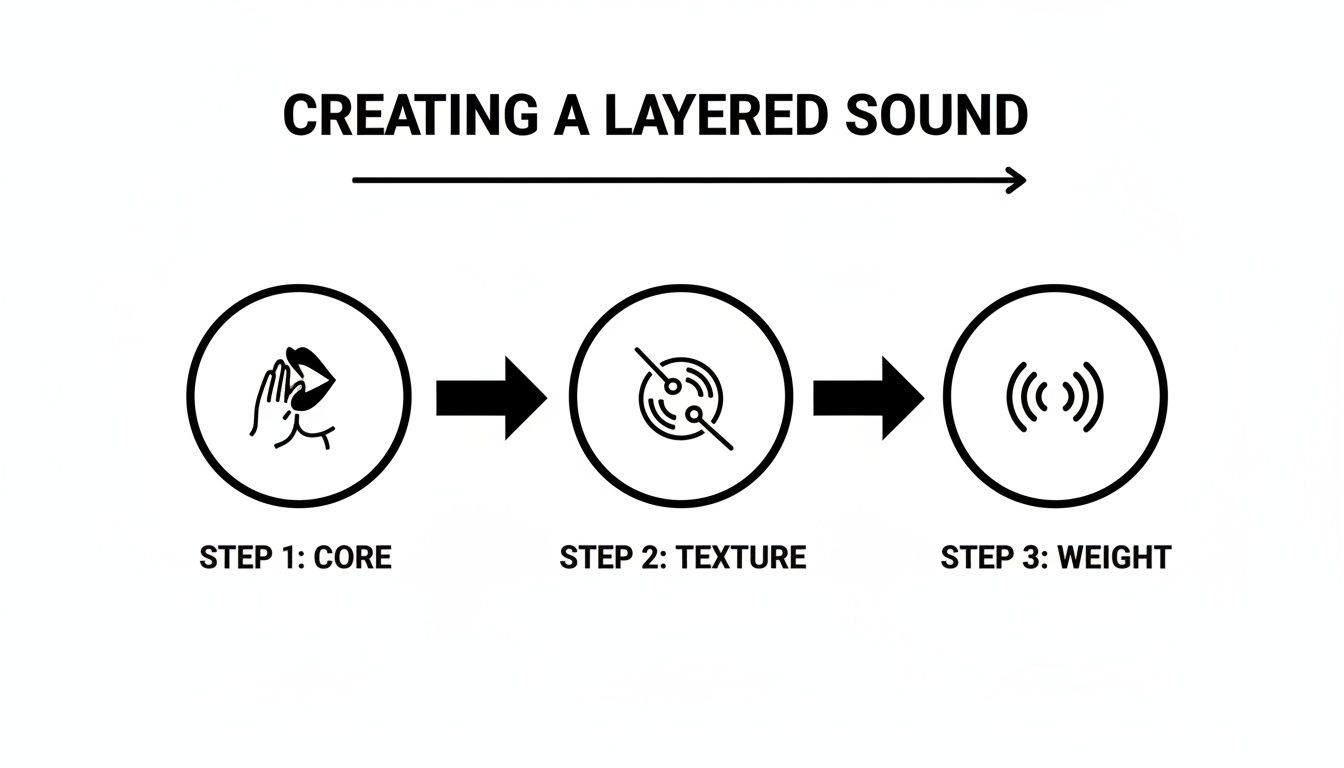
As you can see, even a simple whisper, a cymbal scrape, and a sub-bass tone can become a compelling foundation before a single effect is even applied.
Equalization, or EQ, is always my first stop and arguably the most powerful tool in the chain. Instead of boosting frequencies to make things louder, the secret here is to cut them away. By surgically removing key frequency bands, you can make a sound feel hollow, distant, and completely disembodied.
For instance, a drastic cut in the mid-range (that sweet spot between 500 Hz and 2 kHz) will instantly strip the natural warmth from a voice, leaving behind a cold, ethereal shell. It’s a classic trick for making a whisper sound like it’s coming from another dimension entirely. I also like to use a high-pass filter to roll off the low-end rumble, which makes the sound feel weightless and floaty.
This is how you give your ghost a sense of place—but we're not aiming for realism. We want to create impossible spaces that defy physics and put the listener on edge.
Here are a few of my go-to techniques:
The power of these sounds taps into something deep and primal. In fact, a 2021 survey found that among the 83% of Americans who reported a paranormal event in their home, hearing strange sounds was the most common experience. What we’re doing is recreating a phenomenon that many people genuinely believe they’ve experienced. You can read more about it in the full survey about paranormal experiences in American homes.
A ghost sound should feel like it's occupying a space that shouldn't exist. Your goal with reverb and delay is to build that impossible room—one that's too big, too empty, or simply doesn't follow the rules of the real world.
Finally, I like to add a touch of instability with modulation. Effects like chorus, flangers, and phasers are perfect for adding a shifting, unreliable quality to the sound.
A slow, subtle chorus can make a sound shimmer and drift in and out of tune, creating a nauseating sense of unease. A flanger can add a metallic, sweeping texture, making it feel like the sound is being ripped apart at a molecular level.
A word of caution: use these effects sparingly. A little bit of instability goes a very long way in making something feel wrong.
You’ve designed a spectacular sound effect, but that’s only half the battle. Its true power is only unleashed when it feels like it’s a part of the world you’ve created, whether that's in a film, game, or podcast. A ghost that sounds like it was just pasted on top of the scene loses all its terrifying impact.
This final mixing stage is where the magic happens—where you make your creation feel like it's truly inhabiting the space with your audience.
The most direct tools for this are volume and panning automation. By drawing simple automation curves in your digital audio workstation, you can make a spectral whisper drift slowly from the left speaker to the right, creating a chilling sensation of movement. Think about a ghost passing through a room—its volume should gently swell as it approaches the "camera" and then fade as it recedes into the darkness.
To make your ghostly sound effects truly believable, you need to think about how sound behaves in the real world. This is where equalization (EQ) comes in. It’s your secret weapon for selling the illusion that your entity is in another room, behind a wall, or even lurking just over the listener's shoulder.
Here’s a practical way to think about it:
This all plays on how we've been conditioned to perceive sounds throughout history. The power of auditory phenomena has been documented for centuries, with Victorian-era newspapers often sensationalizing reports of disembodied footsteps and voices. One incredible account even described a crowd of up to 1,000 people gathering to hunt a ghost based on auditory claims alone. It just goes to show how a single reported sound could trigger a massive public reaction.
The goal of mixing isn't just to make the ghost spooky; it's to make it belong. Use EQ and reverb to make your ghost a character within the environment, not just a sound effect layered on top of it.
For maximum impact, especially if your sound will be played in a live setting, the dynamic range of your mix is everything. A truly effective jump scare works because of the contrast between intense quiet and a sudden, loud impact.
Don't be afraid to pull the volume of the ambient track way, way down right before the big scare hits. When planning an event, understanding the essential audio visual equipment for events is critical to ensure your carefully crafted dynamic shifts don't get lost in a poor-quality sound system.
Finally, when you’re ready to export your masterpiece, stick to lossless formats like WAV or AIFF. A sample rate of 48 kHz and a bit depth of 24-bit is the professional standard for film and video, making sure your terrifying creation loses none of its chilling detail.
Even with the best tools and a solid plan, you're bound to hit a few creative snags when designing supernatural audio. Let's walk through some of the questions that come up time and again, so you can get past those hurdles and back to creating.
First up is the eternal software debate. Do you really need a high-end Digital Audio Workstation (DAW) like Pro Tools or Logic Pro? Honestly, no. While they're fantastic, free tools like Audacity or Cakewalk have more than enough muscle for layering, processing, and automating your sounds. The magic isn't in the price tag—it’s in how well you know the fundamentals.
This is easily the most common problem people run into. A "muddy" mix feels cluttered and undefined, where all your spooky layers just blur into a mess. This almost always happens when too many sounds are fighting for space in the same frequency range, particularly in the low-mids between 200-500 Hz.
The secret weapon here is subtractive EQ. Instead of trying to boost the frequencies you like, think about cutting away the ones you don't need. If your main ethereal whisper has a lot of character in the high-mids, use your EQ to gently scoop out a bit of that same range from the other layers. You're essentially carving out a dedicated space for each element to breathe.
A clean mix is an intentional one. Give every sound its own pocket in the frequency spectrum to live in. This single discipline will make your ghostly sound effects sound clearer and more professional than anything else.
An absolutely critical question. If you record everything yourself—dragging a chair across the floor, recording your own whispers—you own the copyright. Go wild. But if you’re using samples you found online, you have to check the license.
To avoid headaches, many designers stick with sounds that are clearly labeled as royalty-free. It just simplifies the entire process. If you want to dive deeper into the legal side of things, check out our guide on royalty-free music and sound effects.
It's also fascinating how our perception of these sounds is rooted in real-world acoustics. Scientific studies have shown how echoes and long reverberations can create audio artifacts that our brains mistakenly interpret as human voices. It’s this natural phenomenon that can make an empty hall feel haunted. You can actually read about the science behind spooky sounds on snowflake.com to get some inspiration for tricking your listener's ear in a similar way.
Ready to create infinite variations of haunting audio with just a text prompt? Try SFX Engine and generate custom, royalty-free ghostly sound effects for your next project. Visit https://sfxengine.com to start for free.